Does improving your click-through rate affect your organic rankings on Google?
For years, this was treated as a debate. Google said clicks were too noisy to use as a ranking signal. SEO professionals pointed to circumstantial evidence and ran experiments. Nobody could settle it definitively.
That changed between 2023 and 2024, when a series of events made the answer overwhelmingly clear.
Google’s Navboost system: confirmed under oath.
In 2023, the U.S. Department of Justice brought its landmark antitrust case against Google. During the trial, internal documents and witness testimony revealed the existence of Navboost — Google’s internal system that uses click data to adjust search rankings.
Navboost wasn’t a surprise to everyone. Industry insiders had suspected something like it for years. But the trial provided something the SEO industry had never had before: sworn confirmation from Google’s own people.
“Clicks are the main signal used by Navboost.”
— Eric Lehman, Google engineer, testimony during DOJ v. Google antitrust trial (2023)
Not “one of many signals.” Not “a minor consideration.” The main signal. Under oath, in a federal courtroom.
Additional testimony from Udi Manber, Google’s former chief of search quality, confirmed the logic behind it:
“The ranking itself is affected by the click data. If we discover that, for a particular query, hypothetically, 80 percent of people click on Result No. 2 and only 10 percent click on Result No. 1, after a while we figure out, well, probably Result 2 is the one people want. So we’ll switch it.”
— Udi Manber, Google’s former chief of search quality, FTC testimony
According to the testimony, Navboost has been in operation since approximately 2005. That means Google has been using click signals to adjust rankings for roughly two decades.
The 2024 API leak: clicks in the code.
Then, in May 2024, over 14,000 internal Google API documents leaked via GitHub. The code exposed the specific mechanics of how Google processes click data for rankings.
Three named click metrics appeared in the documentation: “goodClicks,” “badClicks,” and “lastLongestClicks.” These are production variables in Google’s ranking code — not theories, not correlations, but named fields in the system that determines where your pages rank.
The leak also revealed a system called CRAPS that processes raw click data into demotion scores. Pages that accumulate “badClicks” — where users bounce back to the search results quickly — get pushed down. Pages that earn “goodClicks” and “lastLongestClicks” get a boost.
Rand Fishkin, who first analyzed the leak publicly, called it the most significant leak in Google’s history. When you see click metrics hardcoded into ranking infrastructure, there’s not much room left for ambiguity.
A federal court ordered Google to share its click data.
In August 2024, the federal court in the DOJ antitrust case ruled that Google had illegally maintained a monopoly in search. As part of the remedy, the court ordered Google to share its Navboost click data with competitors — a recognition that this click data is so central to search ranking quality that withholding it constitutes an anticompetitive advantage.
Think about what that implies. A federal judge determined that Google’s click data is so valuable and so integral to ranking results that other search engines can’t compete effectively without access to it.
Google has patented using clicks for rankings.
Beyond the trial and the leak, Google holds multiple patents describing systems that use click data to influence rankings.
“[...] user reactions to particular search results or search result lists may be gauged, so that results on which users often click will receive a higher ranking.”
— Google Patent US8938463
Patents don’t prove a system is in production. But when you combine them with sworn testimony, leaked production code, and a federal court order — the picture is complete.
CTR is one factor among many. But the evidence is overwhelming.
We want to be clear: we are not saying CTR is the only ranking factor. Content quality, backlinks, technical SEO, site speed, and dozens of other signals all play a role. Google’s ranking algorithm considers hundreds of factors.
But the idea that CTR doesn’t matter? That position is no longer defensible. Here’s what we have:
• Sworn testimony from Google engineers calling clicks “the main signal” used by Navboost
• Leaked production code with named click metrics in the ranking infrastructure
• A federal court order requiring Google to share its click data with competitors
• Multiple patents describing click-based ranking systems
• Twenty years of operation — Navboost has been running since approximately 2005
Any one of these alone would be significant. Together, they make the case that CTR affects organic rankings about as strongly as anything can be proven in SEO.
What this means for your SEO strategy.
If you’ve been focused exclusively on content and backlinks, you’ve been working on one side of the equation. The evidence shows that how users interact with your search listings — whether they click, how long they stay, whether they bounce back — feeds directly into Google’s ranking system.
Most SEO strategies completely overlook this. That’s the opportunity.
SerpClix uses real human clickers to boost your organic CTR. Start your free trial or log in to your dashboard.
Importance of Click-through Rate in SEO

Before we discuss whether improving your CTR can boost your organic rankings, we’d like to make this important point: a website can influence its click-through rate on the SERPs through multiple factors, and improving your CTR is a good thing and will help you, regardless of its impact on rankings.
Why? Because a higher CTR means more visitors to your site! And there are a number of positive things you can do to improve CTR outside of SerpClix, such as improving your Title tags or adding a call-to-action to make your listings stand out, optimizing your website structure, to ensure each page is highly matched to target specific (and, ideally, long-tail) keywords, etc.
Whether or not you use SerpClix we would recommend spending some time evaluating your traditional SEO and looking for ways to boost CTR.
But, the question remains: will improving your SEO click through rate help to boost your rankings?
We are going to answer this question in three ways:
- What Makes Sense?
- What Do SEO Experts Think?
- What Does Google Say?
What Makes Sense?

Google’s entire business is built on delivering quality results for organic searches. They want to put the right results in front of the right searcher for the right query. And Google knows that people are more likely to click on higher-ranked results.
On average, click-through rate declines with each ranking decrease. The first search result has by far the highest click-through rate, often 33% or higher for longer-tail keyword terms. The second result can drop to around 15%, the third to around 10%, and so forth.
So, Google wants to give you the right result, and Google knows you are much more likely to click on higher-ranked results.
Imagine that Google sees that, for a given search, the 4th listing has a 5% CTR and the 5th listing has a 10% CTR. The lower-ranked listing is getting a much higher click-through rate - exactly the opposite of what the rankings would normally dictate. Wouldn’t it make sense for Google to conclude that people are more interested in the 5th result than the 4th result? And, having drawn that conclusion, wouldn’t they then be likely to swap those two results, so that the one more people are interested in is shown higher?
What Do the Experts Think?
A few years ago Moz's Rand Fishkin ran a CTR case study which moved his site from #7 to #1 in less than 3 hours by sending clicks to his organic search results.
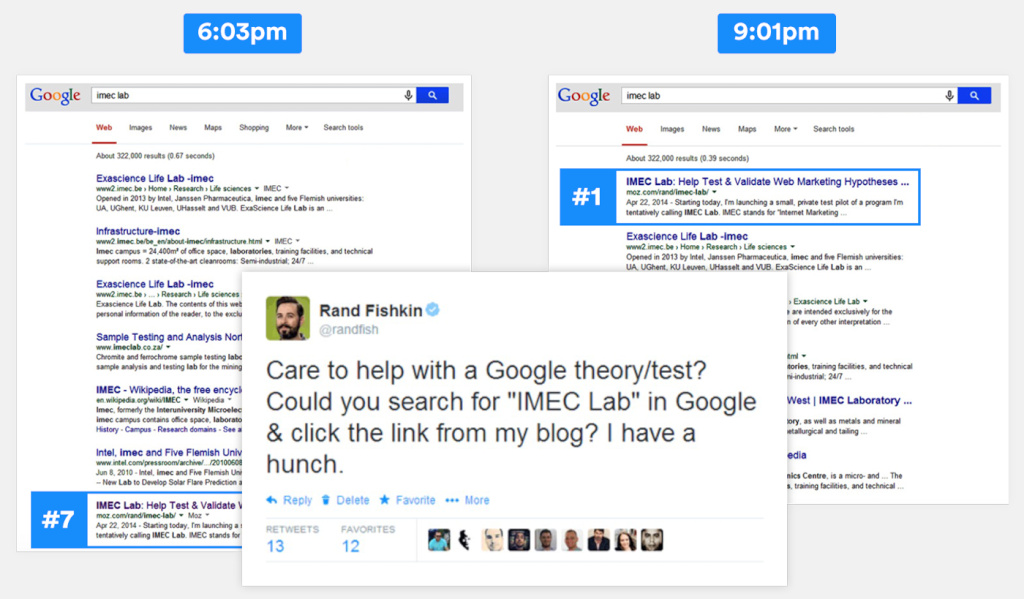
These were real people, making real clicks. This was the first real indication that click through rate (CTR) was a factor that could heavily move organic results in the SERPs.
Since then numerous articles have been published discussing the importance of CTR in organic rankings - here are just a few:
- https://www.wordstream.com/blog/ws/2016/05/5/google-ctr
- https://www.searchenginejournal.com/googles-top-search-ranking-factors-2016-according-searchmetrics-study/181157/
- https://moz.com/blog/impact-of-queries-and-clicks-on-googles-rankings-whiteboard-friday
What Does Google Say?
Google generally does not come out and provide public details about the inner workings of its search ranking algorithm. But details do become public anyways through the following means:
- Loose-lipped Google engineers
- Google’s patent applications
- Lawsuits against Google
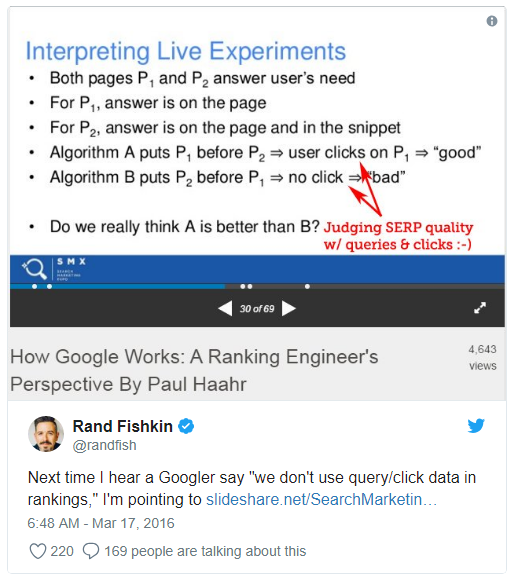
1) For example, here is Rand Fishkin pointing to data from a Google engineer specifically discussing how Google would use click-through data to assess SERP quality in a presentation titled How Google Works: A Ranking Engineer’s Perspective.
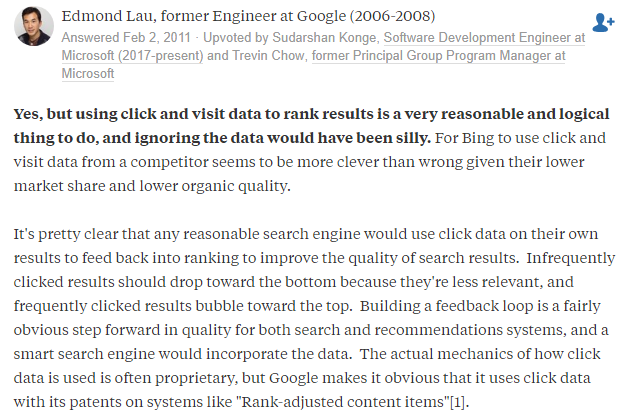
2) And here is a Google engineer posting on Quora, saying:
It's pretty clear that any reasonable search engine would use click data on their own results to feed back into ranking to improve the quality of search results
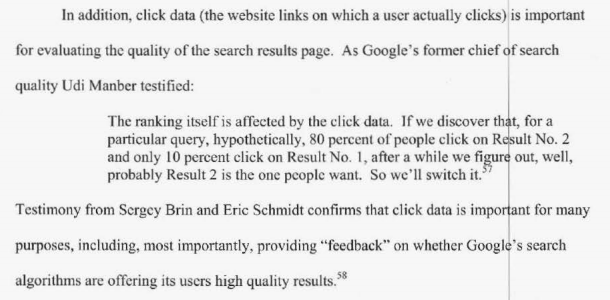
3) Here’s an excerpt from a lawsuit against Google, a copy of which was obtained by the Wall St. Journal, which quotes Google’s former chief of search quality as saying:
The ranking itself is affected by the click data.
He goes on to say:
If we discover that, for a particular query, hypothetically, 80 percent of people click on Result No. 2 and only 10 percent click on Result No. 1, after a while we figure out, well, probably Result 2 is the one people want. So we’ll switch it.
4) And, finally, here is a patent from Google titled “Modifying search result ranking based on implicit user feedback and a model of presentation bias” which says, at one point, the following:
"[…] User reactions to particular search results or search result lists may be gauged, so that results on which users often click will receive a higher ranking."
Conclusion: CTR is an Important SEO Ranking Factor
It seems clear, based on what numerous SEO experts have said, and based on what Google’s own engineers have volunteered, or been forced to say in lawsuits and patents, that click-through rate is an important signal and ranking factor for organic search results.
Please note: there are no guarantees in search engine optimization, ever. There are innumerable factors that can affect search engine rankings. All SEO efforts can involve an element of risk. SerpClix employs real human clickers, so we think our service is far less risky than trying to use automated or robotic click methods. But, like all SEO strategies, there is an element of risk because Google’s algorithm is unknown and subject to change at any time. For more information please see our FAQs.